My Store
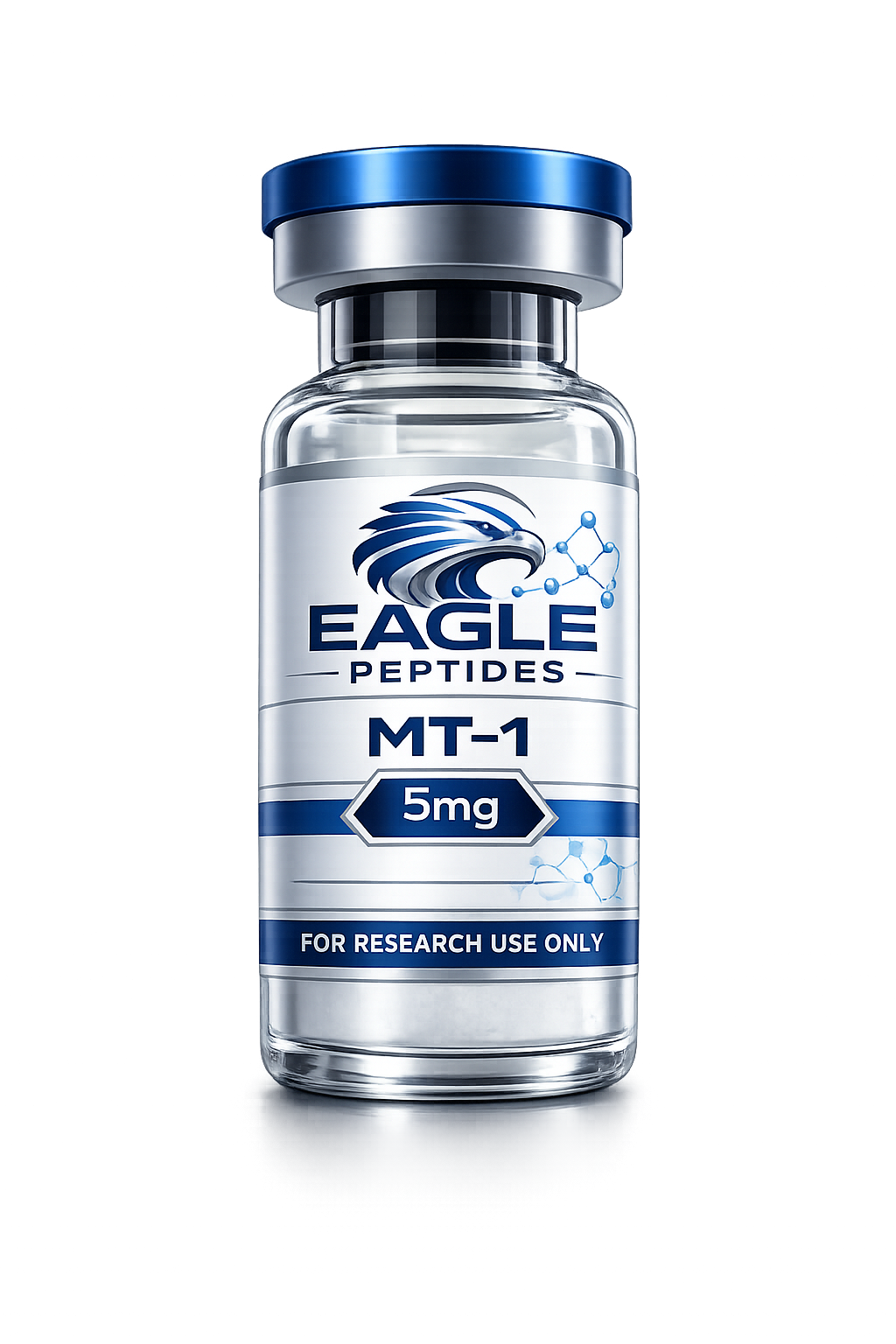
MT-1 (Melanotan 1) 5mg
MT-1 (Melanotan 1) 5mg
Couldn't load pickup availability
Melanotan I (Afamelanotide) Overview
Melanotan I, also known by its international nonproprietary name afamelanotide, is a synthetic linear peptidemodeled after α-melanocyte-stimulating hormone (α-MSH). It acts primarily as a selective melanocortin-1 receptor (MC1R) agonist, which is the receptor responsible for stimulating melanin production in the skin. Unlike Melanotan II, Melanotan I was developed as a pharmaceutical compound and has undergone extensive clinical evaluation.
Afamelanotide is approved in multiple regions (including the EU and U.S.) for specific medical indications related to photosensitivity disorders, rather than for cosmetic tanning.
Pigmentation and Photoprotective Effects
Increases eumelanin production
Clinical studies demonstrate that afamelanotide increases eumelanin (the darker, photoprotective form of melanin) in human skin. Increased eumelanin enhances the skin’s natural defense against ultraviolet (UV) radiation without requiring UV exposure to initiate pigmentation.
Supported by:
Clinuvel Pharmaceuticals; New England Journal of Medicine
Reduces photosensitivity in erythropoietic protoporphyria (EPP)
Afamelanotide has been extensively studied in patients with erythropoietic protoporphyria (EPP), a rare genetic disorder characterized by severe pain following light exposure. Randomized, placebo-controlled Phase 3 trials showed that afamelanotide significantly increased pain-free sunlight exposure time and improved quality-of-life measures in affected patients.
Supported by:
Langendonk et al., New England Journal of Medicine
Mechanism of Action
Melanotan I selectively activates MC1R on melanocytes, leading to increased melanogenesis and a shift toward eumelanin production. Unlike Melanotan II, it has minimal activity at other melanocortin receptors, which is why it lacks many of the systemic side effects associated with non-selective melanocortin agonists. This receptor selectivity underlies its more favorable safety profile in clinical use.
Supported by:
Hadley & Dorr, Endocrine Reviews
Safety Profile and Regulatory Status
Clinical safety data
Across multiple controlled clinical trials and long-term observational studies in EPP patients, afamelanotide demonstrated a generally favorable safety profile when administered as a controlled, subcutaneous implant. The most commonly reported adverse effects were mild and transient, including headache, nausea, and injection-site reactions.
Supported by:
Langendonk et al., NEJM; Harms et al., British Journal of Dermatology
Regulatory approval
Afamelanotide is approved by:
-
European Medicines Agency (EMA) for EPP
-
U.S. Food and Drug Administration (FDA) for EPP under restricted distribution
It is not approved for cosmetic tanning or general photoprotection in healthy individuals.
Melanotan I (Afamelanotide) Specifications
-
CAS Number: 75921-69-6
-
Molecular Formula: C₇₈H₁₁₁N₂₁O₁₉
-
Molecular Weight: ~1646.9 g/mol
-
Peptide Class: Linear α-MSH analog
-
Primary Receptor Target: MC1R
-
Form (approved drug): Subcutaneous implant (controlled-release)
(Research catalogs may list lyophilized peptide forms that are not equivalent to the approved pharmaceutical product.)
Important Notice
Melanotan I (afamelanotide) is a prescription medication with a specific FDA- and EMA-approved indication for erythropoietic protoporphyria. It must not be marketed or represented as a cosmetic tanning agent, dietary supplement, or general photoprotective product. Any non-approved forms should be clearly designated for in vitro research use only.
References
-
Langendonk JG, et al. Afamelanotide for erythropoietic protoporphyria. New England Journal of Medicine(2015).
https://www.nejm.org/doi/full/10.1056/NEJMoa1411481 -
Harms J, et al. Long-term safety and efficacy of afamelanotide in erythropoietic protoporphyria. British Journal of Dermatology (2019).
https://pubmed.ncbi.nlm.nih.gov/30859605/ -
Dorr RT, et al. Linear and cyclic melanocortin analogs: pharmacology and clinical development. Peptides(review).
https://pubmed.ncbi.nlm.nih.gov/10518576/ -
Hadley ME, Dorr RT. Melanocortin peptide biology and receptor selectivity. Endocrine Reviews.
https://pubmed.ncbi.nlm.nih.gov/11974610/ -
U.S. FDA. Afamelanotide (SCENESSE) prescribing and approval information.
https://www.accessdata.fda.gov/drugsatfda_docs/nda/2019/210797Orig1s000TOC.cfm -
European Medicines Agency (EMA). Scenesse (afamelanotide) EPAR.
https://www.ema.europa.eu/en/medicines/human/EPAR/scenesse -
NIH PubChem. Afamelanotide compound summary (CAS, formula, molecular weight).
https://pubchem.ncbi.nlm.nih.gov/compound/Afamelanotide
Complete Disclaimer
This product is sold exclusively for laboratory research purposes under Section 351 of the Public Health Service Act. It is not intended for human or veterinary use, nor for diagnostic, therapeutic, or cosmetic applications. Purchaser certifies they are properly licensed and equipped to handle research compounds in compliance with all local, state, and federal regulations. EaglePeptidesUSA assumes no liability for misuse or unauthorized handling. By purchasing, you affirm this material will not be introduced into interstate commerce or used in food/drug products.
Share